
How Tapirs Use Their Prehensile Proboscis to Grasp and Feed


Introduction
When we think about specialized tools in nature, we often picture the sharp claws of a predator or the powerful jaws of a hunter. However, the tapir offers a different kind of evolutionary masterclass: the ability to manipulate an environment through precision rather than force. At the center of this ability is the proboscis—a short, highly flexible, prehensile nose trunk that acts as a specialized interface between the animal and its food source. Rather than relying on brute strength to break branches, the tapir uses this organ to grasp, pull, and select exactly what it needs to survive.
Understanding how a tapir uses its proboscis to grasp and feed provides a fascinating look at how biological “tools” are adapted to overcome specific sensory and physical limitations. For the tapir, this isn’t just a nose; it is a hand, a sensory probe, and a survival mechanism rolled into one.
The Anatomy of Precision: What is a Proboscis?

Unlike the long, muscular trunks of elephants, the tapir’s proboscis is relatively short and highly mobile. Its unique functionality comes from its physical composition. According to 1, the proboscis consists almost entirely of soft tissues rather than internal bony structures. This lack of bone is precisely what allows for such extreme flexibility, enabling the snout to move in all directions to navigate dense foliage.
This anatomical setup also influences the overall skull shape of the Tapiridae family, creating a specialized head structure optimized for this “grabbing” lifestyle. It is important to note that not all tapirs are built exactly the same; there is significant variation in these physical capabilities depending on the species. For instance, Malayan tapirs possess the longest snouts, while Brazilian tapirs have the shortest 1.
How the Proboscis Functions in Foraging
The primary role of the proboscis is to expand the tapir’s “reach.” Because tapirs are herbivores that rely on specific types of vegetation, they need to be able to select the most nutritious items from thick brush. The proboscis allows them to perform several key feeding tasks:
- Targeted Grasping: The prehensile nature of the snout allows the tapir to grasp and manipulate foliage that would otherwise be out of reach or too delicate to handle with a mouth alone.
- Selective Feeding: They use the snout to pick through various plant types, focusing on fruit, berries, and young, tender leaves 1.
- High-Volume Consumption: This efficiency is necessary for their metabolic needs. To put this in perspective, Baird’s tapirs have been observed consuming approximately 40 kg (85 lb) of vegetation in a single day 1.
Beyond Eating: The Nose as a Sensory Tool
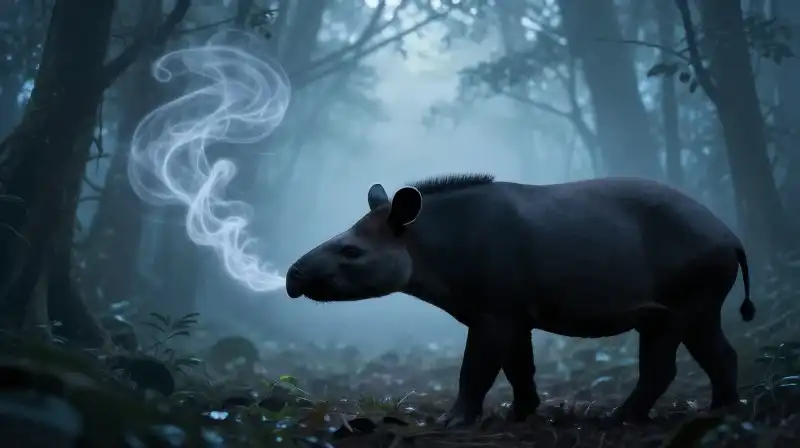
The proboscis isn’t just a mechanical tool for grabbing food; it is also a vital sensory organ. This is particularly important because tapirs have relatively limited vision, often characterized by monocular vision and potential corneal cloudiness in some species 1. To compensate for what they cannot see, they lean heavily on their sense of smell and hearing.
One of the most specialized uses of the snout is the “flehmen response.” In this behavior, the tapir raises its snout and shows its teeth to better detect and process scents 1. This is more than just a curious movement; it is a critical social tool. Males, in particular, use this scent-detection behavior to monitor their environment for social cues, such as the presence of other males or signs that a female is in oestrus 1.
Comparing Tapir Species Capabilities
While all tapirs share the fundamental trait of the proboscis, their physical adaptations vary to suit their specific habitats. The following table highlights the differences in snout length and specialized adaptations mentioned in the research:
| Feature/Species | Variation/Trait | Functional Purpose |
|---|---|---|
| Malayan Tapir | Longest snout | Maximum reach for grasping foliage. |
| Brazilian Tapir | Shortest snout | Adapted for different foraging styles. |
| Baird’s Tapir | High consumption rate | Capable of eating up to 40 kg of vegetation daily. |
| General Adaptation | Splayed, hooved toes | Navigating muddy or soft ground textures. |
Common Questions About Tapirs

Are tapirs dangerous? Can a tapir kill you?
While tapirs are herbivores and generally not aggressive toward humans, they are large, powerful animals. Their size and strength, combined with their ability to navigate difficult terrain with splayed, hooved toes, means they can be formidable if they feel cornered or threatened 1.
What do tapirs eat?
Tapirs are opportunistic herbivores. They use their specialized anatomy to consume a wide variety of vegetation, including berries, fruits, and tender young leaves 1.
How many tapirs are left in the world?
While specific population numbers fluctuate by species, tapirs are a focus of conservation efforts due to habitat loss. Their survival is closely tied to the preservation of the specific forest environments where their foraging methods are most effective.
Summary: The Power of Specialized Adaptation
The tapir reminds us that survival isn’t always about being the strongest or the fastest; often, it is about being the most precise. By evolving a proboscis that can grasp and manipulate delicate food sources, and by using that same organ to “read” the chemical signals of their environment through the flehmen response, tapirs have mastered a niche that vision-heavy predators cannot. When observing these animals, remember that their “nose” is actually a sophisticated multi-tool—essential for feeding, social navigation, and compensating for a limited visual world.
References
Footnotes
Related Articles